


Learning lessons on the Goretta Pillar – failing is the best inspiration
Decision time.
We all knew this moment was coming. Jacob, Pet and I had all been thinking about it as we pushed on, far behind schedule. Now we finally stopped at a belay to make a plan.
We had just joined the main line of the Casorotto route on the Goretta Pillar of Fitzroy. Above us soared a tower of golden granite and splitter cracks, glowing in the evening sun. The climbing looked absolutely delightful. The weather was perfect, the views incredible. THIS is what we had come for.
But it was 8pm, and darkness was coming.

It had taken us all day to climb just seven approach pitches and traverse across the pillar. Progress had been slowed by many factors; Snow, route-finding mistakes, heavy packs, dehydration, cold hands. Needing to aid pitches I'd hoped to be able to free climb.
We’d planned to reach the top of the pillar today—around 20 pitches. Instead, we looked down and realised a single abseil would take us to the col between Mermoz and Fitzroy. So after a full day of climbing… we had just reached the start.

I had to laugh. It felt strangely good to be so shut down by the mountain. It made the Goretta Pillar feel even bigger and more magnificent. I felt inspired and motivated to come back better one day.
We knew we couldn’t summit anymore. Even if the weather held for an extra day, we were limited by gas. We barely had enough for dinner, let alone melting snow, and we were already dehydrated. But we had bivy gear, good weather, and beautiful rock above us. So we decided to spend the night at the col, in order to enjoy some nice climbing the next day on the pillar before descending.
That night, as we ate our half-rehydrated potato mash, we reflected on what we’d learned so far.....
1. The snow
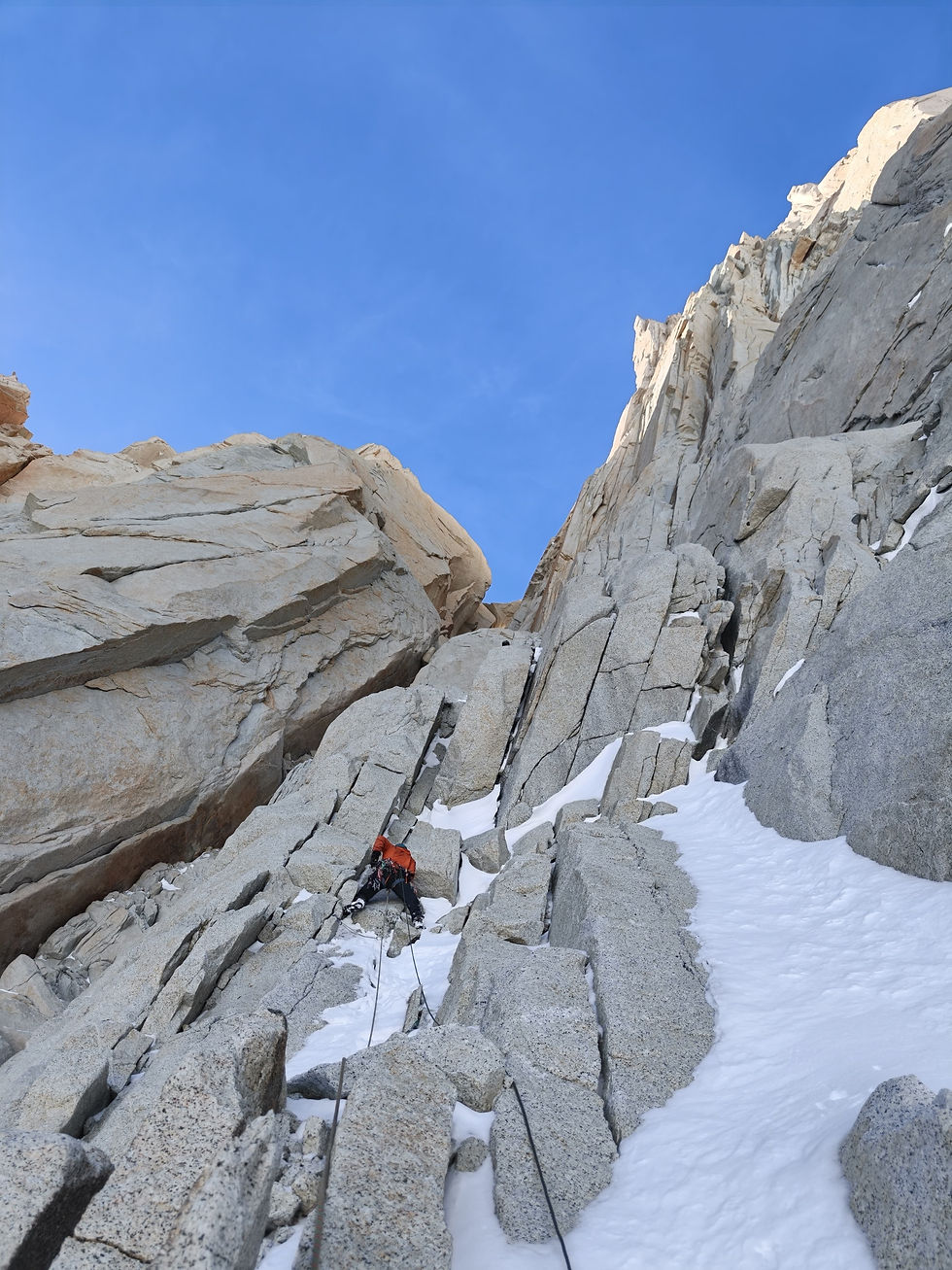
It had snowed for two days before our climb, transforming everything. Summer had changed to winter. Most of the approach we were post-holing to our knees—or falling to our hips— slowing us down and consuming energy. We underestimated the time to plug up the slope to the base of the pillar and started climbing too late.

Then the first four pitches were covered in snow, slowing progress again.
In Patagonia, snow-covered rock is a common problem, especially on the low-angle pitches that otherwise would be quick and easy. What to do? Rock shoes or boots? Frozen painful fingers, slipping in snow patches in wet climbing shoes? Or clumsy movement, trying to smear an easy slab in rigid boots? We tried both, and neither felt efficient.
I'm still not sure of the best solution. Maybe it just takes more experience— or simply accepting that snow slows everything down and allowing time for that.
2. The cold
Despite all the hype about the fantastic weather window, it was freezing the entire time.
We thought it was a good idea to choose a north-facing route for sun. But in these temperatures the cracks stayed icy and the rock painfully cold. Everything felt harder, took longer, and we needed to carry more gear, slowing us further.
In hindsight, it wasn’t the right weather window to give the best chance of success on this route. A better objective for a cold window like this might be something shorter to allow for the slower climbing conditions, or a route where more time can be spent climbing in boots and gloves.
Still, over the two days we climbed 19 pitches of rock. Here are a few things that helped:
Wearing liner gloves under our crack gloves. Works fine for jamming!
Rock shoes a size to large to fit socks
Seconders wearing boots and jugging when it’s really too cold
Block leading to settle into a mode and manage clothing layers

3. Climbing strategy
We wanted to enjoy the world-class splitter crack climbing, so we decided to haul a bag and have the seconders fix-and-follow. However, our haul bag was only 40L—far too small for three people with bivy and mountaineering gear. The overflow had to go into the seconders’ backpacks, making them too heavy to climb with.
So the seconders ended up jugging anyway—but we didn’t have jumars, only microtraxions. Meanwhile, the leader was still spending time and energy hauling, instead of short-fixing and continuing to move up the wall.
We had ended up doing a bit of two different strategies, but not doing either one properly - making it inefficient and more tiring for everyone.

The lesson: pick one system and do it well.
Either:
Aim for efficiency and warmth: seconders jug with all the gear in their packs, staying warm in boots and gloves, while the leader short-fixes and keeps moving.
Or prioritise free climbing: fix-and-follow, but make sure all the gear is in the haul bag so the seconders aren’t carrying anything and can actually enjoy the climbing.
4. Gas

We didn’t bring enough. Big mistake.
I remember the feeling of horror as I picked up the gas can after our first bivy. It was awfully light, almost empty. The freezing cold temperatures had made the gas far less efficient. We figured we had enough left for one more dinner/breakfast—but not enough for melting all our drinking water.
So we set off with just 500ml of water in each of our nalgenes, hoping to find water on route when the sun melted the snow. But we didn’t.
By the time we reached our decision point, we were thirsty, and the gas rations become our biggest limiting factor. It was frustrating—but also great learning - I’ll never make that mistake again!
Next time: in freezing temps melting snow, at least one medium canister (230g) per night for 2–3 people.
The next day – great climbing, a cold descent, dehydration
That night at the tent, I worried about being thirsty. We rationed our water strictly and were only allowed a mouthful each. I knew I would be too dehydrated to climb well the next day, but Jacob and Pet seemed to be functioning better and were excited to take the lead. I agreed I could manage to second until we found water.

So all morning as I followed along, I ate snow. Surprisingly, after a few hours, it actually helped a little. Enough for me to appreciate our epic position on the pillar and our surroundings. For a few hours, the sun warmed the wall and it was pleasant. I watched Pet and Jacob cruising above me on lead and felt proud of them.

But the moment we lost the sun, the cold hit hard. Instantly, my joy turned into anxiety.
At a belay, Pet arrived shaking. We put on all our layers. When I met Jacob at the next belay I explained how cold we were, and the focus switched to getting down. We climbed the last two pitches to take us to the rap line (12 pitches total that day).
It was a cold and long descent. I was wearing so many layers—thermal, two fleeces, three down jackets—and still was cold. I couldn’t stop dreaming about my sunny outdoor sofa at home. In hindsight, dehydration was making it harder to keep warm too.
The rappels were complex, with old anchors that needed backing up. The ropes kept getting stuck and we had to climb back up many times. I was very glad to be there with partners I trusted.

Eventually, we made it back to the col, got warm in the tent, squeezed one last boil from the gas, and slept briefly before finishing the rappels the next morning. A little more walking down to the glacier, and finally, delicious running water!

As we walked out, I reflected on one more important lesson I had been learning in Patagonia…
5. Self-awareness and stamina
Stamina: the physical or mental capacity to sustain a prolonged stressful effort.
To push through stress and suffering on a mountain, you need to really want to be there. The desire to keep going has to outweigh the desire to be comfortable.

By the time we started this trip, I knew my stamina was running low—not just physically, but mentally and emotionally too.
The last ten days since arriving in El Chalten had been all go-go-go. I’d come straight from Cochamo, arrived at 9.30pm, walked into Piedra Negra that night with Jacob, climbed Mermoz the next day. Two days later we climbed Fitzroy via the Franco-Argentine —with a very cold bivy on the descent, waking covered in snow in -15°c. Cold enough that I had felt scared and I needed time to recover from that stress.
Links to youtube videos of our ascents of Pilar Rojo on Mermoz and the Franco-Argentine:
But instead after just one day in town I joined friends to climb Aguja Pollone, a lovely trip, but I was still mentally drained and that got me down. Then we had just two days in town - barely enough to sleep, eat, and repack - before heading out again to the Goretta Pillar.
And zooming out further, it had already been a big year—life changes outside climbing, plus an expedition to Greenland a few months earlier, which had also involved a very cold night out. And in the back of my mind, another big trip (Trango Tower) was coming up, and I wanted to save energy for that.
So I knew the fuel tank was running low.
But Patagonia doesn’t offer many perfect weather windows, especially with good partners. It felt hard to say no. (Besides, we chose a sunny north-facing route so it would be warm… HA!)

On the pillar, when things got tough, I noticed my lower stamina. Even though I’d been excited for the climb, I didn’t really want to be pushing myself anymore. Deep down, I wanted to be sitting on my sunny outdoor couch at home with a cup of coffee - warm, comfortable and refuelling.
In the end, it was definitely worth it. It was an epic, challenging and memorable experience.
But it also helped me learn: if I keep trying to climb big objectives on an empty tank, I’ll burn out. So I’m learning to be aware of my stamina tank—to recognise when I need rest and refuelling, and when I’m actually ready for the next challenge.


Comments